
The pop isn't the point. Here's what's actually happening when you get adjusted.
Most people have a mental picture of what a chiropractic adjustment is: you lie on a table, something cracks, and you walk out feeling better. The crack becomes the event. The satisfying pop becomes the proof that something happened.
But the pop is not the point. It's not even particularly relevant. That sound is simply gas releasing from a joint capsule under pressure — the same thing that happens when you crack your knuckles. It tells you nothing about whether the adjustment was effective, and it has nothing to do with the mechanism that actually produces change in the body.
What actually happens during an adjustment is far more interesting — and far more significant — than the sound.
Start here: what is a subluxation?
Before we can talk about how an adjustment works, we need to talk about what it's actually correcting. The target of a neurologically-focused chiropractic adjustment isn't muscle soreness or general stiffness. It's something called a subluxation — and it has three specific components that all have to be present for the term to apply:
Physical Misalignment
The vertebra is out of its proper position — not dramatically, but enough to matter. This is the structural component most people think of when they think of chiropractic.
Joint Fixation
The joint is stuck — not moving through its full range the way it's designed to. This fixation is what reduces the quality of information flowing between the body and brain through that segment.
Neurological Interference
This is the one that matters most. The misalignment and fixation together disrupt the neurosensory communication running through that segment of the spine — creating static on the line between the brain and body. Disrupted signaling, not pain, is the real problem a subluxation creates.
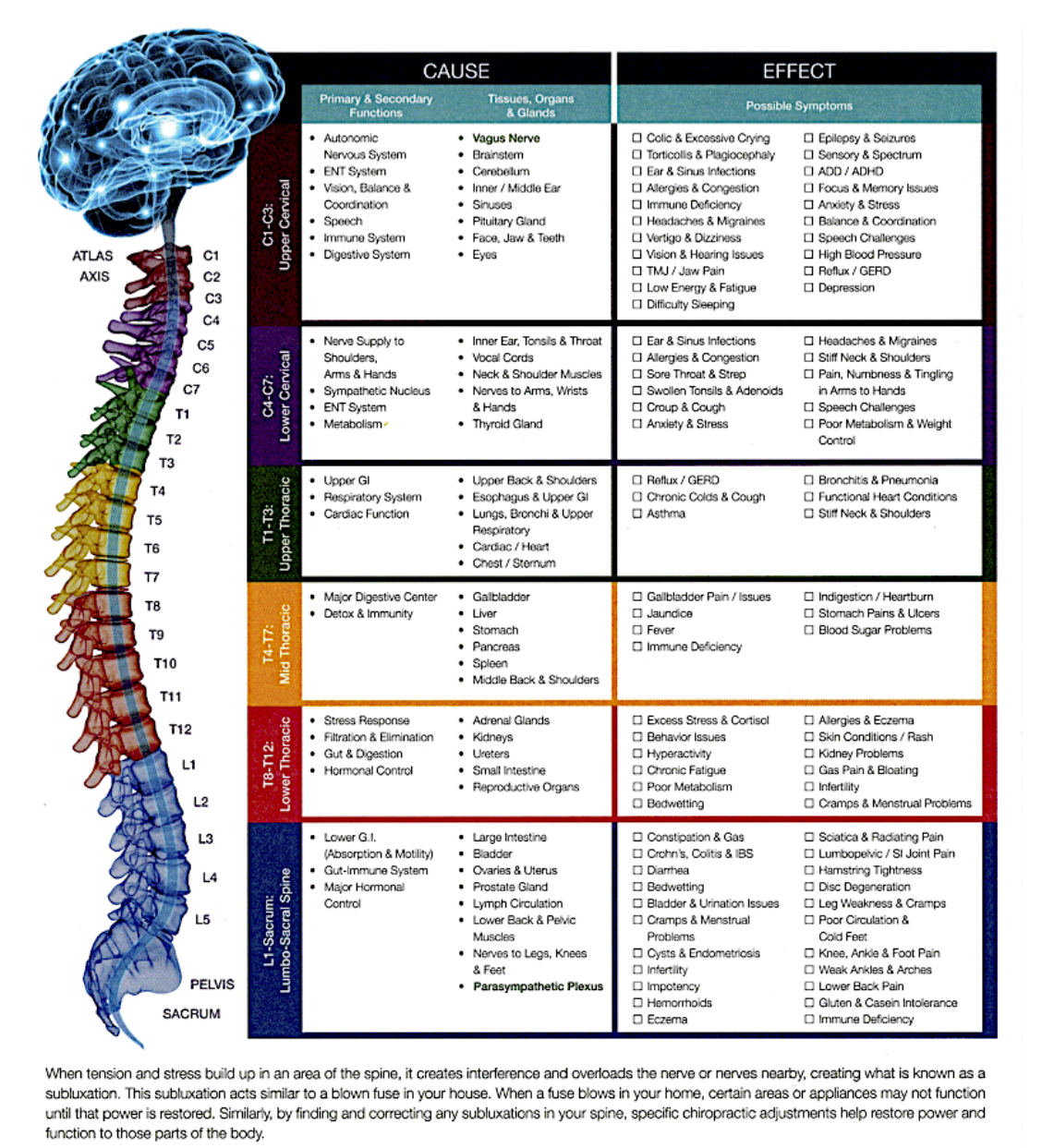
All three components have to be present. And importantly — subluxations don't always hurt. Most neurological interference is silent. The body compensates, adapts, and keeps functioning — just not as well as it should. That's why people are often surprised by what their scans reveal. The spine and nervous system can be significantly dysregulated long before pain ever shows up.
What the adjustment actually does: the four-step cascade
When a specific, targeted adjustment is delivered to a subluxated segment, it triggers a neurological cascade — a sequence of events that moves from the spine to the brainstem to the cortex to the autonomic nervous system. Here's what that sequence looks like, in plain language:
Step 1:Mechanoreceptor activation
The muscles and joint capsules surrounding the spine contain a dense network of mechanoreceptors — sensory nerve endings that detect movement, pressure, and position. The paraspinal muscles actually have the highest concentration of these receptors anywhere in the body. When the adjustment is delivered, it produces an immediate burst of sensory input through these receptors. This is where the neurological event begins — not in the bone, but in the tissue that surrounds it.
Step 2: Brainstem reception
That burst of sensory information travels up through the spinal cord and arrives at the brainstem — the control center for heart rate, breathing, digestion, arousal, and the overall tone of the autonomic nervous system. The brainstem receives the new input and begins updating its read of what's happening in the body. Think of it as the brain receiving a signal it hasn't been getting clearly, suddenly coming through without the static that was there before.
Step 3: Cortical integration
The signal continues upward to the cortex — including the prefrontal cortex, which governs executive function, emotional regulation, decision-making, and pain processing. Research published in the journal Neural Plasticity demonstrated measurable changes in prefrontal cortex activity following a single adjustment of a dysfunctional spinal segment. The brain re-reads the body's position, tone, and tension — and redistributes its processing resources accordingly. This is why patients often notice mental clarity, calmer moods, and reduced pain perception after care, not just physical relief.
Step 4: Autonomic shift
The final and most consequential step. With the brainstem and cortex now receiving clearer input, the vagus nerve and parasympathetic system engage — shifting the nervous system out of sympathetic "fight or flight" dominance and toward the parasympathetic "rest, digest, and recover" state. This is the shift that explains why people sleep better, digest better, feel calmer, and get sick less after consistent care. It's not coincidence. It's the downstream result of a nervous system that's finally able to regulate again.
Why is the adjustment so gentle and so fast?
Parents often walk out of their child's first appointment wondering if enough actually happened. The adjustment took 90 seconds. Nothing dramatic. No cracking. Just a light, specific contact — and then it was done.
That's by design. For children — especially those whose nervous systems are already overstimulated and dysregulated — a shorter, more targeted input is more effective, not less. A child's nervous system doesn't need more sensory load. It needs a precise, specific signal delivered to exactly the right place. The pressure used is comparable to the amount you'd use to test whether a piece of fruit is ripe. Gentle, specific, and intentional.
The actual integration and rewiring happens in the 24–72 hours after the adjustment — not on the table. The adjustment is the catalyst. The nervous system does the rest.
How we know exactly where to adjust, and whether it's working
Because subluxations don't always produce pain, we don't rely on pain as a guide for where the interference is coming from. That's where the INSiGHT CLA neurospinal scan comes in. Before any care begins, we use the scan to get an objective, measurable picture of how the nervous system is functioning — where the autonomic system is dysregulated, where tension is concentrated along the spine, and how well the body is balancing stress and recovery.
That data tells us where to focus, what techniques to use, and how to build a care plan specific to what your nervous system actually needs. We rescan throughout care so you can see — in measurable, objective terms — how your nervous system is shifting in response to adjustments. Not just how you feel on any given day, but real data showing the change that's happening underneath.
We don't guess. We look. And then we adjust accordingly.
