
What is HRV, and why are all wearables tracking it now?
Your OURA ring tracks your HRV, but do you know what it’s actually telling you?
Heart rate variability has gone mainstream. Oura rings, Apple Watches, Whoop bands, etc. More people than ever are waking up and checking their HRV score before they even get out of bed. And that's genuinely great, people are paying attention to a metric that actually matters.
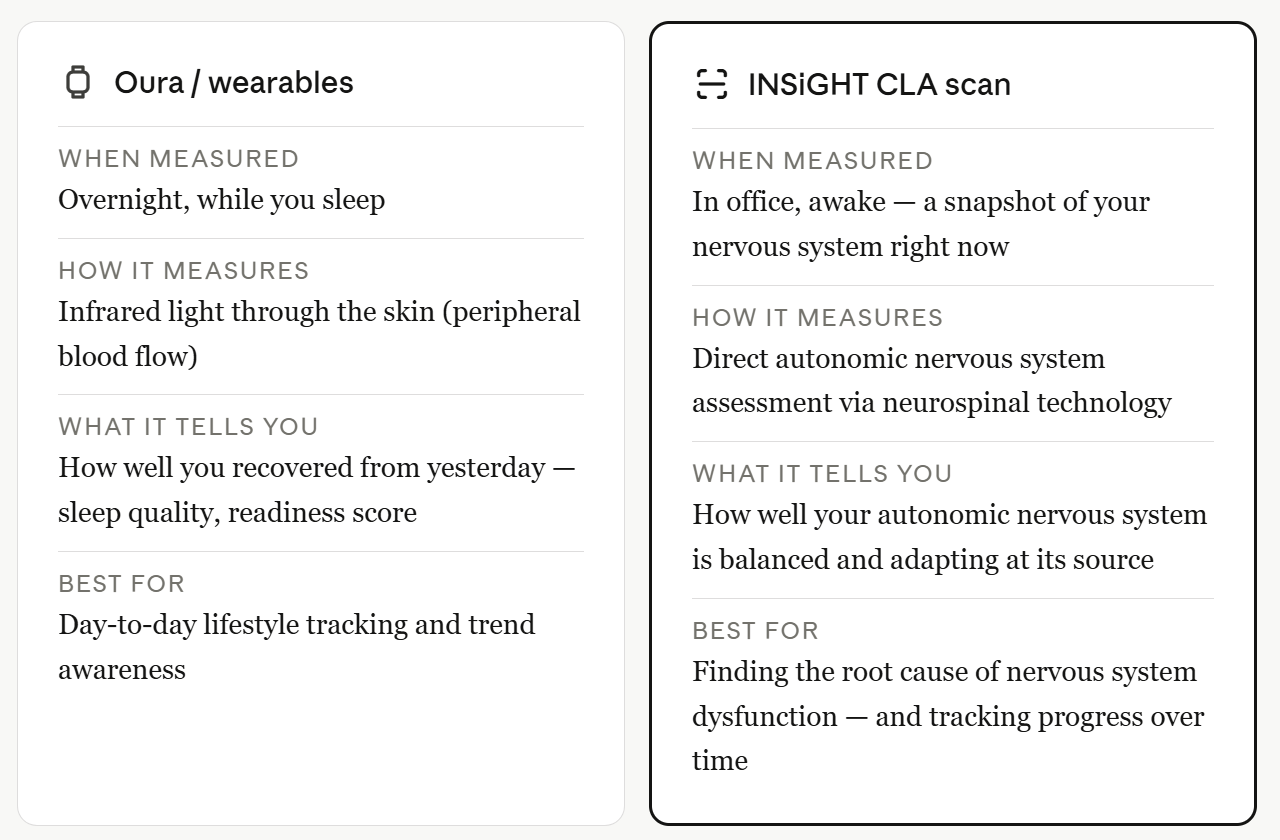
But here's what most people don't know: the HRV number on your wearable and the HRV we measure in the office are telling you two very different things. One tells you how your body recovered last night. The other tells you how well your nervous system is functioning at its root.
Understanding the difference could change everything about how you approach your health.
What is HRV, really?
Your heart doesn't beat like a metronome. There's actually a slight variation in the time between each beat — and that variation is what we call heart rate variability. More variation is generally better. It means your nervous system is adaptable and responsive.
HRV is controlled by your autonomic nervous system — specifically the balance between your sympathetic ("fight or flight") and parasympathetic ("rest and digest") branches. When you're healthy, rested, and not under excessive stress, these two branches communicate smoothly. That smooth back-and-forth shows up as high HRV. When you're depleted, inflamed, or your nervous system is under chronic stress, that balance breaks down — and HRV drops.
Signs your HRV may be low
You don't need a wearable to notice the signals. Low HRV often shows up as:
Waking up tired even after a full night of sleep
Brain fog, poor focus, or difficulty making decisions
Anxiety, irritability, or feeling emotionally reactive
Slow recovery after exercise or physical activity
Getting sick often or feeling like you can't fully recover
Digestive issues, tension headaches, or chronic muscle tightness
Sound familiar? These are signals your nervous system is stuck in overdrive — and they're easy to dismiss as "just stress" or "just getting older." But they're not inevitable. They're measurable. And they're addressable.
Why this matters for your chiropractic care
Spinal misalignments create interference in your nervous system, and that interference directly impacts your autonomic balance. When the spine isn't moving properly, it creates a kind of static on the line between your brain and body. Over time, that static shows up as low HRV, poor recovery, and all the symptoms that come with it.
Chiropractic adjustments remove that interference. And one of the clearest ways we can show you that your care is working — objectively, not just by how you feel — is through improving HRV scores on your INSiGHT scans over time.
